


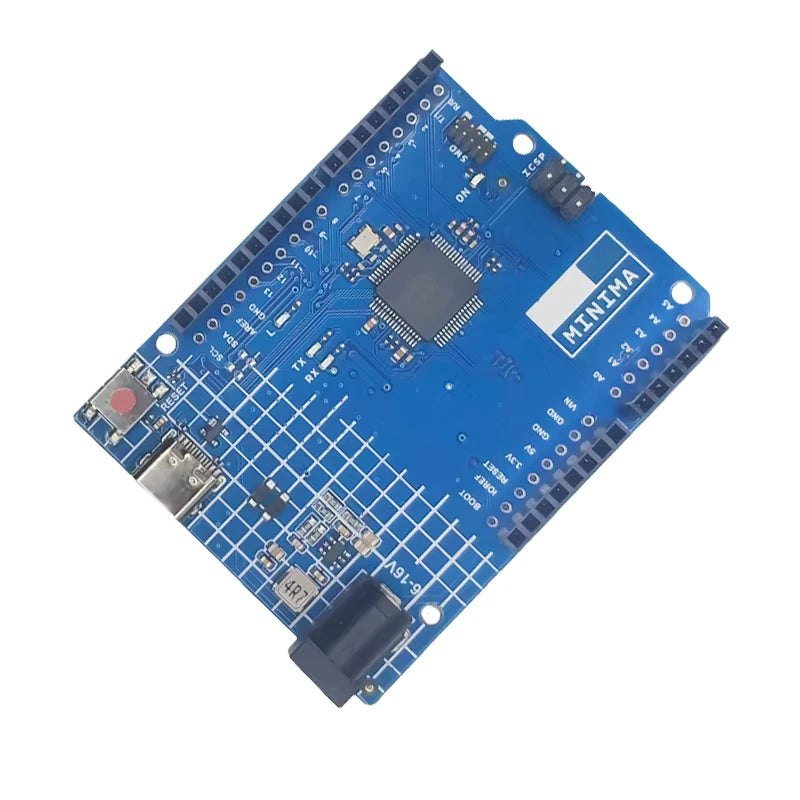
UNO R4 Rev4 Minima Compatible Development Board Microcontroller
UNO R4 Rev4 Minima Compatible Development Board Microcontroller
Order Code: 34-116
Out of stock
Couldn't load pickup availability

Product Description
Explore our selection of Uno R4 compatible clone boards, offering the same powerful features as the official Arduino Uno R4 Minima and Uno R4 WiFi at a more affordable price. These boards maintain full compatibility with the Arduino ecosystem, making them ideal for prototyping, IoT applications, and DIY projects.
Compatible with UNO R4 Minima – High-Performance Microcontroller for Advanced Projects
The UNO R4 Minima is a powerful development board featuring the Renesas RA4M1 microcontroller with a 32-bit ARM Cortex-M4 core running at 48 MHz. Designed for embedded applications, it offers enhanced processing power, expanded memory, and a variety of onboard peripherals—all while maintaining the classic UNO form factor for seamless compatibility with existing shields and accessories.
Key Features:
- Optimized Performance: The 32-bit ARM Cortex-M4 core ensures efficient processing and low power consumption, ideal for demanding applications.
- Flexible Connectivity: Features a modern USB-C port for power and programming, along with CAN BUS support for robust communication in industrial and automotive applications.
- Advanced Analog Capabilities: Equipped with a 12-bit DAC and operational amplifier for precise analog signal processing, making it perfect for audio, sensor integration, and signal generation.
- Seamless Debugging: Includes an SWD (Serial Wire Debug) connector for professional-grade debugging, programming, and real-time system monitoring.
- Expanded Power Support: Supports input voltages up to 24V, enabling easy integration with motors, LED strips, and actuators without additional power management.
- HID Functionality: Can function as a keyboard or mouse when connected to a computer, enabling seamless interaction with software applications.
- Familiar UNO Form Factor: Maintains the pinout, 5V operating voltage, and overall design of the UNO R3, ensuring compatibility with a vast ecosystem of shields and accessories.
Ideal for IoT, robotics, industrial control, and embedded systems, the UNO R4 Minima provides a powerful yet compact platform for innovation.
Uno R4 vs Uno R3: Key Advantages
The Uno has been the cornerstone of the maker movement for nearly two decades, with the R3 version becoming the de facto standard for electronics hobbyists and educators worldwide. With the introduction of the R4 series (available in both Minima and WiFi variants)
Comprehensive Comparison Table
| Feature Category | Specific Feature | Uno R3 | Uno R4 Minima | Uno R4 WiFi |
|---|---|---|---|---|
| Processor | Microcontroller | ATmega328P | Renesas R7FA4M1AB | Renesas R7FA4M1AB + ESP32-S3-MINI |
| Architecture | 8-bit AVR | 32-bit ARM Cortex-M4F | 32-bit ARM Cortex-M4F + 32-bit Xtensa | |
| Clock Speed | 16 MHz | 48 MHz | 48 MHz (main), 240 MHz (WiFi coprocessor) | |
| Floating Point Unit | No | Yes | Yes | |
| Memory | Flash Memory | 32 KB (0.5 KB bootloader) | 256 KB + bootrom | 256 KB + bootrom |
| SRAM | 2 KB | 32 KB (with ECC) | 32 KB (with ECC) | |
| EEPROM/Data Flash | 1 KB EEPROM | 8 KB data flash | 8 KB data flash | |
| I/O | Digital I/O Pins | 14 (6 PWM) | 14 (compatible layout) | 14 (compatible layout) |
| Analog Inputs | 6 (10-bit resolution) | 6 (14-bit resolution) | 6 (14-bit resolution) | |
| Digital-to-Analog | None | 12-bit DAC | 12-bit DAC | |
| Built-in Display | No | No | 12×8 LED matrix | |
| Communication | UART/USART | 1 | 4 | 4 |
| SPI | 1 | 2 | 2 | |
| I²C | 1 | 2 | 2 | |
| WiFi | No | No | IEEE 802.11 b/g/n | |
| Bluetooth | No | No | Bluetooth 5 LE | |
| USB | Full-Speed (via adapter) | Full-Speed (native) | Full-Speed (native) | |
| CAN Bus | No | Yes | Yes | |
| Physical | USB Connector | USB-B | USB-C | USB-C |
| Power Input Range | 7-12V (max 20V) | Up to 24V | Up to 24V | |
| Qwiic/STEMMA QT Connector | No | No | Yes (3.3V) | |
| Programming Interfaces | USB | USB, SWD | USB, SWD, Wireless | |
| Special Features | RTC Battery Header | No | No | Yes (VRTC pin) |
| Remote-Off Header | No | No | Yes | |
| Advanced Peripherals | No | DMA, CRC, RNG, Crypto, Touch | DMA, CRC, RNG, Crypto, Touch | |
| Wireless Uploading | No | No | Yes | |
| Software | Arduino C/C++ | Yes | Yes | Yes |
| MicroPython | No | Yes | Yes | |
| Library Compatibility | Extensive, mature | Growing | Growing | |
| Best Uses | Educational/Basic Projects | Excellent | Good | Good |
| Complex Computing Needs | Limited | Excellent | Excellent | |
| Wireless/IoT Projects | Requires shields | Requires shields | Built-in | |
| Visual Output Projects | Requires components | Requires components | Built-in LED matrix | |
| Legacy Project Compatibility | Excellent | Good (some adaptation) | Good (some adaptation) | |
| Price Point | Relative Cost | Lowest | Medium | Highest |
Conclusion
This comprehensive comparison illustrates the significant advancements the Uno R4 series brings to the Arduino ecosystem. The R4 models feature dramatically improved processing power, memory resources, and peripheral capabilities while maintaining compatibility with the classic Uno form factor.
The R3 continues to excel in educational settings and basic projects with its mature ecosystem and wide compatibility. The R4 Minima offers a substantial performance upgrade for more demanding applications, while the R4 WiFi adds built-in wireless connectivity and visual feedback capabilities that would require additional components on other boards.
For makers looking to advance beyond the limitations of the R3, the R4 series provides a natural progression path without requiring users to learn an entirely new platform, making it an excellent choice for both new and experienced enthusiasts.
Are Arduino Uno R4 shields compatible with the Uno R3?
Yes, Arduino deliberately engineered the Uno R4 series (both Minima and WiFi versions) to maintain backward compatibility with the extensive ecosystem of shields created for the Uno R3. The R4 boards preserve the identical pin layout, form factor, and electrical specifications that shield designers have relied on for years. This means that virtually all existing Uno R3 shields can be attached directly to an R4 board without modification.
Brands we provide
























- Choosing a selection results in a full page refresh.
- Opens in a new window.