Skip to product information
1 of 5

MitchElectronics Equipment Pack VCO/PWM/Generator/Power Supply Solder Kits

MitchElectronics Equipment Pack VCO/PWM/Generator/Power Supply Solder Kits

Regular price £18.99
Regular price Sale price £18.99
Sale Sold out

Order Code: 33-050

Delivery calculated at checkout.

Quantity

3 in stock

View full details

Product Description

The Equipment Pack by MitchElectronics is a versatile four-piece soldering kit designed for anyone looking to explore core electronic building blocks and signal generation. This DIY electronics kit includes a PWM Generator, Voltage Controlled Oscillator (VCO), Simple Function Generator, and a Simple Power Supply, making it ideal for students, hobbyists, and makers who want hands-on experience with essential circuit concepts. Each build-it-yourself module introduces key principles such as waveform generation, frequency control, and power regulation, helping users develop practical soldering skills while deepening their understanding of analog electronics. Perfect for STEM education, prototyping, or expanding your electronics toolkit, the MitchElectronics Equipment Pack delivers an engaging and educational experience that supports both learning and experimentation.


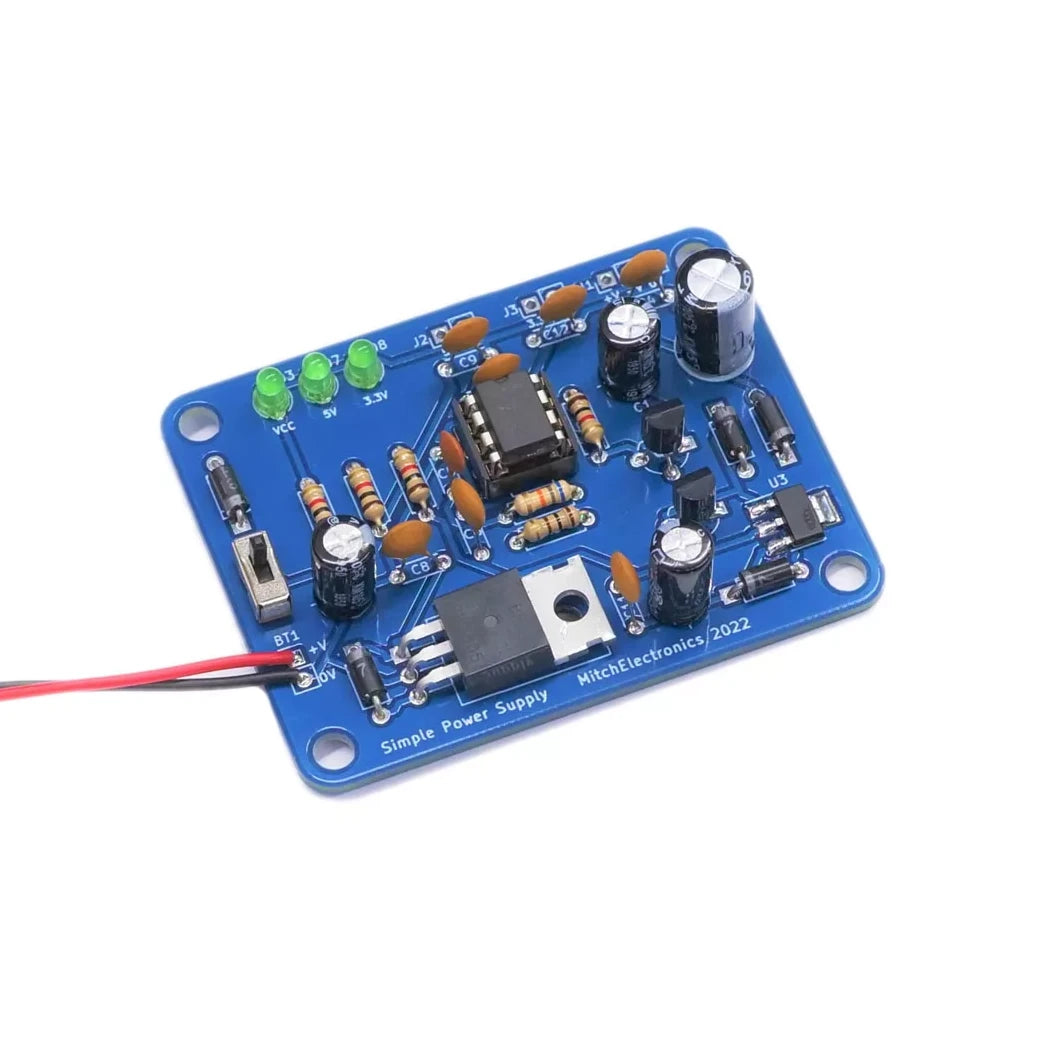
Simple Power Supply

The simple power supply is the power kit for you providing 5V, -9V, and 3.3V all from a single 9V battery. Excellent project for beginners and learners alike!

While power sources such as 9V and AA batteries can be used to power some kits directly not every kit can handle these unregulated voltages. For example, any kit with an active buzzer requires a 5V source and some other kits (such as the M602 Door Bell) can only handle up to 4V! Generating these voltages can be cumbersome and any project that requires more than a single 5V source may prove challenging. This is where the Simple Power Supply comes in! This kit is directly powered from a 9V battery and provides many different outputs including 

  • 9V Out
  • -9V (approx)
  • 5V Out
  • 3.3V Out

This kit generates the 3.3V with the use of the AMS1117 which is an SMD part. However, this is a very easy component to solder (arguably one of the easiest SMD parts to solder) and can provide great soldering practice for surface mount devices!

Product specifics

  • Component Count: 42
  • Battery Powered?: Yes, 9V PP3
  • Operating Voltage: 7V to 16V
  • Operating Frequency: N/A
  • Output Voltage: 9V, -9V, 5V, 3.3V
  • Output Current: 100mA all rails except -9V
  • Dimensions (PCB) : 59mm x 43mm
  • Mounting Holes: Yes
  • Prebuilt: No – Kit form
  • Batteries Not Included

Included in this kit

  • 1 x 8 DIP Socket
  • 1 x 555
  • 1 x 2N3904
  • 1 x 2N3906
  • 1 x 7805
  • 1 x AMS1117
  • 1 x 100R Resistor
  • 4 x 1K Resistors
  • 1 x 100K Resistor
  • 1 x 1nF Capacitor
  • 7 x 100nF Capacitors
  • 3 x 100uF Capacitors
  • 1 x 470uF Capacitor
  • 5 x 1N5817 Diodes
  • 3 x Green LEDs
  • 1 x Small Slide Switch
  • 3 x Red Wire
  • 1 x Blue Wire
  • 3 x Black Wire
  • 1 x PP3 Connector
  • 1 x PCB

Applications

The Simple Power Supply is an ideal first kit to get if other MitchElectronics kits are to be used (as many other kits require a 5V or 3V source). The Simple Power Supply is also ideal for students who need to practice soldering as well as understand how power circuits work. Furthermore, the mounting holes on the Simple Power Supply combined with the various outputs makes this kit ideal for use with DT projects that combine multiple elements including circuit construction, enclosure design, and crafting in order to create a small safe power supply.

Instructions

Click here...


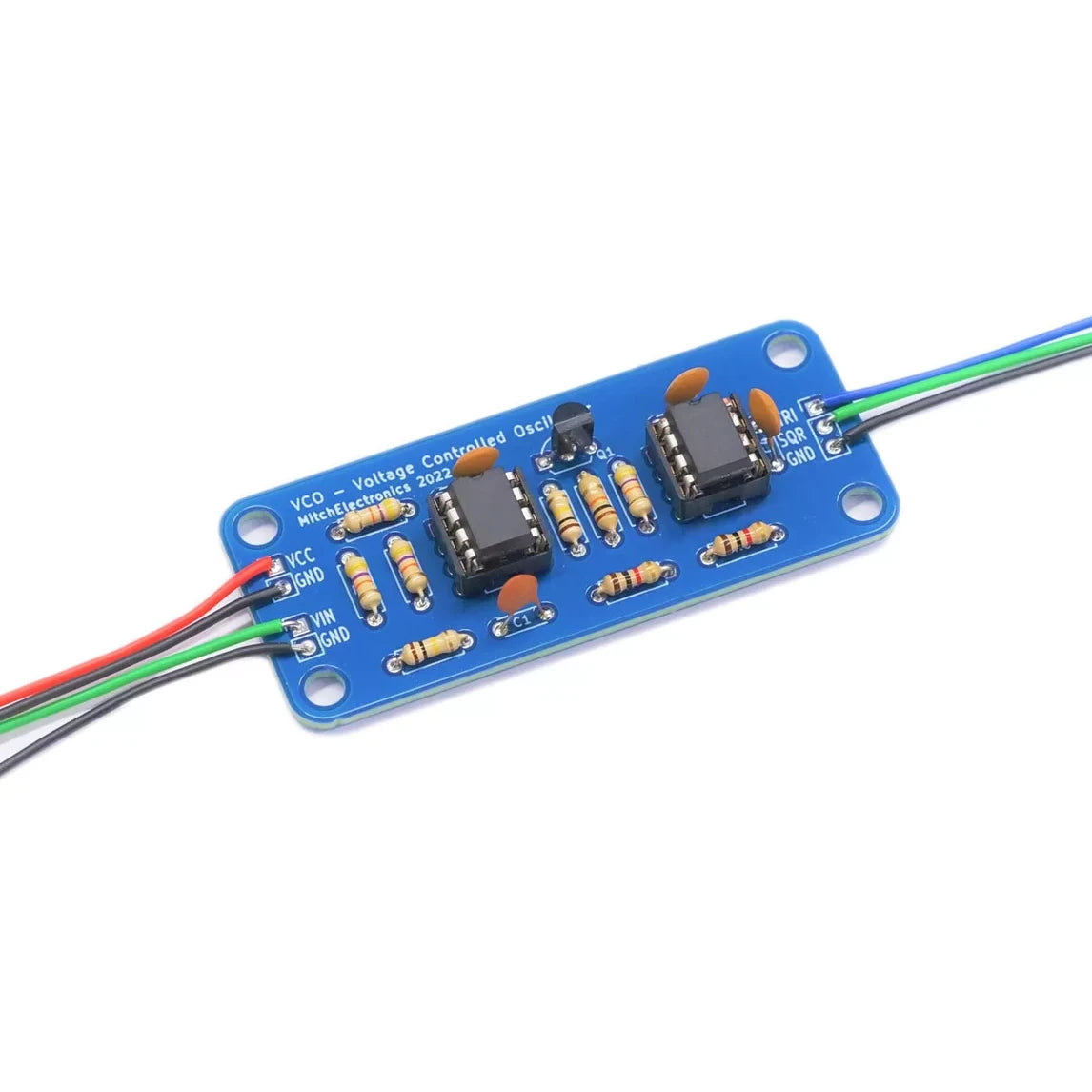
Voltage Controlled Oscillator

Need an oscillator whose output frequency is adjustable with a voltage? Then look no further, as this kit by MitchElectronics will let you build a voltage-controlled oscillator!

An excellent project for beginners and learners alike!

The Voltage Controlled Oscillator (VCO for short), is a very practical circuit for generating square and sine waves. While these waves can be produced using the Simple Function Generator Kit, the VCO allows for controlling the output frequency with the use of a voltage signal instead o using a potentiometer. This means that the output frequency of the VCO can easily be controlled by microcontrollers and other analogue circuits which can create some pretty interesting results. For example, a 1V octave synthesiser can be built using this module whereby a 1V octave keyboard is connected to an exponential converter which feeds its output into the VCO to produce keyboard tones. This circuit can also be used in retro ways such as sensor data transmission where the voltage output of a sensor is converted into a frequency and the frequency of the output will be proportional to the sensor reading (a similar system was done in early satellites such as Sputnik).

Product specifics

  • Component Count: 23
  • Battery Powered?: No
  • Operating Voltage: 5V to 16V
  • Operating Frequency: 0Hz to 36KHz (at 5V)
  • Output Voltage: VCC – 1.5V
  • Output Current: N/A
  • Dimensions (PCB): 60mm x 22mm
  • Mounting Holes: Yes
  • Prebuilt: No – Kit form
  • Batteries Not Included

Included in this kit

  • 2 x 8 DIP Socket
  • 2 x LM358
  • 2 x 1K Resistors
  • 1 x 10K Resistor
  • 4 x 47K Resistors
  • 2 x 100K Resistors
  • 1 x 1nF Capacitor
  • 3 x 100nF Capacitors
  • 1 x 2N3904
  • 1 x Red Wire
  • 1 x Green Wire
  • 1 x Blue Wire
  • 1 x Black Wire
  • 1 x PCB

Applications

The VCO is an ideal kit for those learning about oscillator circuits built around the LM358, and the ability to control the VCO with an external voltage source also makes the kit ideal for projects that have voltage-producing sensors. Applications for the VCO kit include synthesisers, function generators, matched square/triangle waveforms, switch-mode power supplies, and PWM generators.

Instructions

Click here...


PWM Generator 

If you are in need of a PWM signal source for testing purposes then look no further as this kit by MitchElectronics will let you create your own PWM generator! Perfect for beginners!

PWM Signals are those that have variable duty cycles and are found in many thousands of circuits. Just a few examples of how PWM signals can be used include Digital-To-Analog conversion, high-efficiency power controllers, servo control, timing, and much more. This kit will allow you to build a simple PWM generator that runs on voltages between 5V-28V and has two potentiometers for adjusting both the frequency of the PWM wave and the duty cycle between 0% and 100%.

Product specifics

  • Component Count: 18
  • Battery Powered?: No
  • Operating Voltage: 5V to 20V
  • Operating Frequency: Variable
  • Output Voltage: Square (0V to VCC – 1.5V)
  • Output Current : Max 20mA
  • Dimensions (PCB) : 46mm x 29mm
  • Mounting Holes: Yes
  • Prebuilt: No – Kit form
  • Batteries Not Included

Included in this kit

  • 2 x 8 DIP Socket
  • 2 x LM358
  • 3 x 100nF Capacitors
  • 1 x 47K Resistor
  • 3 x 100K Resistors
  • 2 x 100K Potentiometer
  • 1 x Red Wire
  • 1 x Blue Wire
  • 2 x Black Wire
  • 1 x PCB

Applications

The PWM Generator is an ideal kit for those teaching op-amps and the various circuit configurations they can be used. Furthermore, the kit also teaches about positive feedback and how to convert a triangular wave into a PWM signal. The small component count combined with the two large potentiometers makes an ideal product for a DIY function generator that is to be mounted inside an enclosure, and the construction time of less than an hour is also ideal for use in the classroom.

Instructions

Click here...


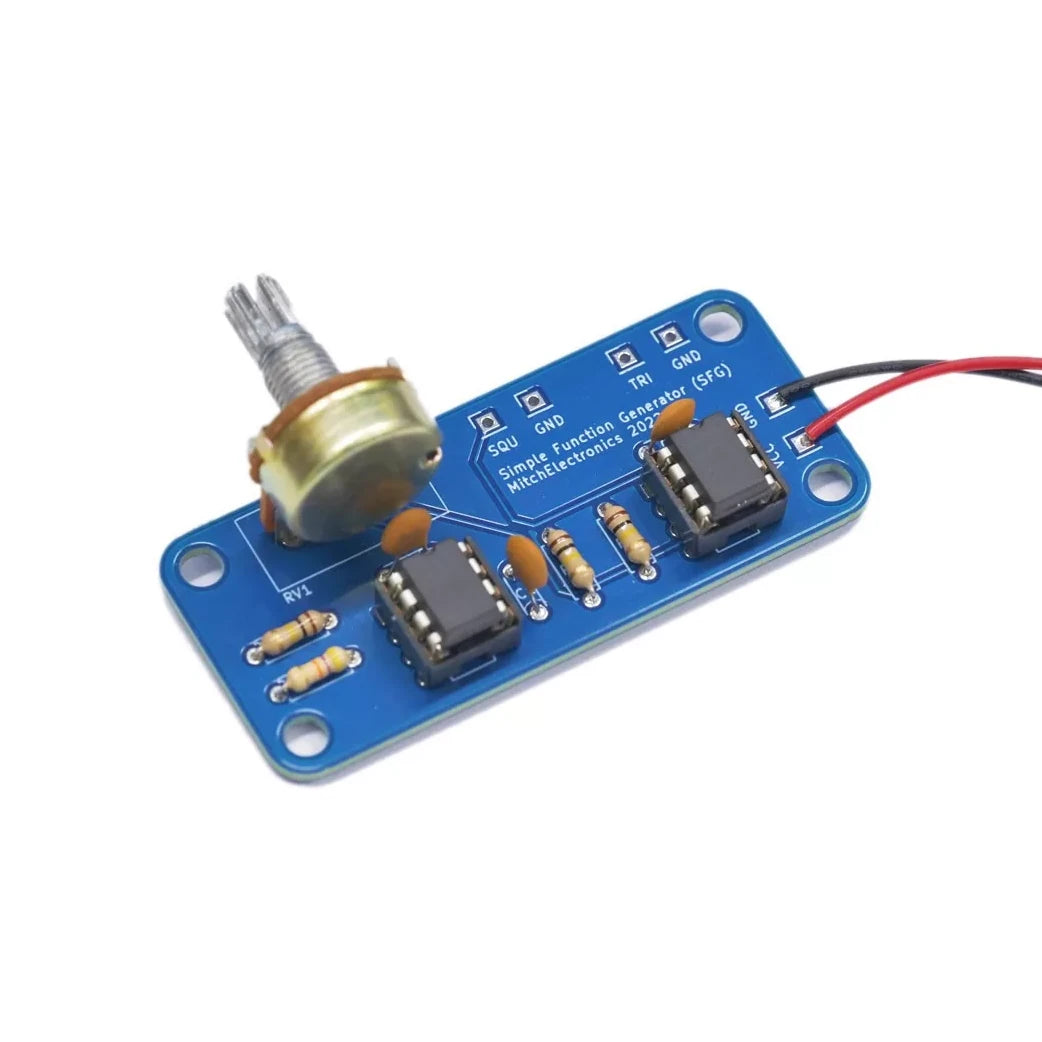
Simple Function Generator

Need a basic function generator with variable triangular and square waveforms? Then look no further as this kit by MitchElectronics will allow you to build your own simple function generator! Excellent project for beginners and learners alike!

In just about every electronic circuit there will be some signal that changes with time and in many circuits, this signal may be continuous. For example, the electricity from the mains supply has a sinusoidal shape (like an ocean wave). Another example would be the clock for a computer that has a square shape.

Imagine a scenario where a digital circuit has been created and requires a clock from an external source. One could be built especially for the task however the clock source would most likely have a fixed frequency. Even if one was designed to have a variable frequency (which takes time), the device would only output a square wave. This is where the humble function generator steps in!

Not only does the SFG (Simple Function Generator), have both a square and triangle output but the frequency is also adjustable. The square and triangle wave are generated by the same source and thus are always in the same phase which means that the two waveforms follow each other constantly (useful if both waves are being used). But how does this circuit work? What active devices are used to create the oscillations and how is the frequency adjusted? Let’s find out!

Product specifics

  • Component Count: 16
  • Battery Powered?: No
  • Operating Voltage: 5V to 20V
  • Operating Frequency: Variable
  • Output Voltage: Square (0V to VCC – 1.5V)
  • Output Current : Max 20mA
  • Dimensions (PCB) : 52mm x 27mm
  • Mounting Holes: Yes
  • Prebuilt: No – Kit form
  • Batteries Not Included

Included in this kit

  • 2 x 8 DIP Socket
  • 2 x LM358
  • 3 x 100nF Capacitors
  • 1 x 47K Resistor
  • 3 x 100K Resistors
  • 1 x 100K Potentiometer
  • 1 x Red Wire
  • 1 x Blue Wire
  • 1 x Green Wire
  • 2 x Black Wire
  • 1 x PCB

Applications

The Simple Function Generator is an ideal kit for teaching oscillator circuits using op-amps, and how function generators can be used to help test other circuits. The Simple Function Generator also has a very small component counting making it possible to be built in under an hour. As such, this kit is highly ideal for use in the classroom as a teaching resource on both circuit concepts and construction. Furthermore, the kit is ideal for those who need to incorporate an analogue function generator module that may otherwise be too cumbersome to design from scratch.

Instructions

Click here...


Notes

Note that product specifics such as output frequency depend on the tolerance of the components. The numbers provided here are an approximation only.

All parts sold by MitchElectronics are compliant with RoHS and REACH directives which ensure that they can be used in commercial environments as well as complying with environmental laws.